Distributed by Design, Coupled by Accident: The Hidden Costs of Microservices at Scale
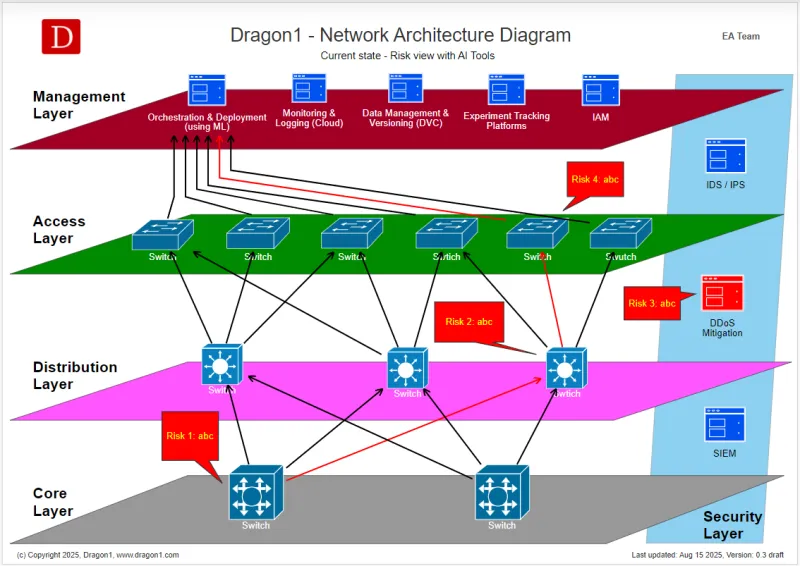
Photo: complex enterprise software architecture network diagram server infrastructure, via www.dragon1.com
For much of the past decade, microservices architecture has been positioned as the inevitable destination for any enterprise serious about digital agility. Technology leaders at organizations ranging from regional banks to Fortune 500 retailers have invested heavily in decomposing large, tightly bound applications into smaller, independently deployable services. The promise was straightforward: smaller codebases, autonomous teams, faster release cycles, and the ability to scale individual components without touching the rest of the system.
What many of those organizations discovered — often after considerable investment — is that the complexity does not disappear. It migrates.
The seams between services become new points of failure. The organizational boundaries that were supposed to mirror service boundaries frequently do not. And the operational overhead of running dozens or hundreds of independent services can quietly erode the velocity gains that justified the migration in the first place.
The Illusion of Independence
The foundational appeal of microservices rests on the principle of loose coupling. If Service A and Service B can evolve independently, teams can ship faster, roll back safely, and reason about smaller scopes of code. In theory, this is sound. In practice, enterprises routinely underestimate how many implicit contracts exist between services — contracts that no architecture diagram captures.
Consider a common enterprise scenario: an order management service, a customer profile service, and an inventory service, each owned by a separate team. On paper, they are independent. In production, a schema change in the customer profile service silently breaks the order management service's API contract. The inventory service begins returning stale data during a network partition, and the order service has no graceful degradation path. These are not theoretical edge cases. They are the operational reality that emerges when distributed systems meet the entropy of large organizations.
This phenomenon is sometimes called a distributed monolith — a system that has been physically separated but remains logically entangled. Teams cannot deploy independently because their services share databases, rely on synchronous call chains, or depend on shared libraries that version-lock them together. The worst outcome is an architecture that carries the operational burden of microservices without delivering the autonomy they were meant to create.
When the Org Chart Becomes the Architecture
Conway's Law — the observation that systems tend to mirror the communication structures of the organizations that build them — is frequently cited as a reason to adopt microservices. Align your services to your team boundaries, the argument goes, and both will evolve more cleanly.
But the inverse problem is equally common and less discussed: organizations restructure their services without restructuring their teams, or restructure their teams without the governance models needed to enforce clean service ownership. The result is ambiguous ownership, inconsistent API standards across service boundaries, and inter-team dependencies that are negotiated informally rather than managed systematically.
Enterprise architecture leaders who have navigated this transition successfully tend to emphasize that microservices are, at their core, an organizational strategy as much as a technical one. The technology is the easy part. Defining domain ownership, establishing API versioning policies, building shared observability tooling, and creating the platform engineering capabilities that allow teams to operate independently — these are the harder problems, and they require sustained investment that many initial business cases do not account for.
The Case for Reassessing the Monolith
Not every enterprise application is a candidate for decomposition, and the industry has begun to reckon with this more honestly. The monolith — long treated as a synonym for legacy debt — is being reconsidered as a legitimate architectural choice for specific contexts.
A well-structured monolith with clear internal module boundaries, a mature deployment pipeline, and a small-to-medium team can outperform a loosely governed microservices environment in several dimensions: lower operational overhead, simpler debugging, easier data consistency, and faster onboarding for new engineers. For enterprises in early-stage digital transformation, or those operating in domains where transactional consistency is paramount, a modular monolith may represent a more pragmatic path than a premature leap to full service decomposition.
The question is not whether microservices are good or bad. The question is whether the organizational and operational conditions exist to make them work.
A Framework for Assessing Operational Maturity
Before committing to a microservices migration — or before extending an existing one — enterprise technology leaders should evaluate readiness across five dimensions:
1. Observability Infrastructure. Can your teams trace a single user request across service boundaries in near real time? Without distributed tracing, centralized logging, and meaningful alerting, debugging production failures in a distributed system becomes exponentially more expensive.
2. Deployment Automation. Do your teams have mature CI/CD pipelines capable of independently deploying, testing, and rolling back individual services? Manual or semi-manual release processes negate much of the speed advantage microservices are supposed to deliver.
3. Domain Ownership Clarity. Can each service be attributed to a single team with clear accountability for its uptime, API contracts, and evolution? Shared ownership is a warning sign.
4. API Governance. Does your organization have enforced standards for API design, versioning, and deprecation? Inconsistent contracts between services are among the most common sources of hidden coupling.
5. Failure Tolerance Design. Are your services designed to degrade gracefully when upstream dependencies fail? Synchronous call chains without circuit breakers or fallback strategies are a systemic risk in any distributed environment.
Organizations that score well across these dimensions are genuinely positioned to extract value from microservices. Those that cannot confidently answer these questions should treat decomposition as a destination to be reached incrementally — not a starting point.
The Path Forward
Microservices architecture, executed with the appropriate operational maturity, remains one of the most effective approaches for enabling enterprise-scale digital delivery. The organizations that have succeeded with it — and sustained those gains — did so by treating the architecture as an ongoing discipline rather than a one-time migration project.
For technology leaders evaluating their current state, the most valuable question to ask is not "Are we using microservices?" but rather "Are we capturing the benefits we designed them to deliver?" If the honest answer reveals hidden coupling, unclear ownership, or operational complexity that slows rather than accelerates delivery, the work is not to abandon the approach — it is to build the organizational and technical foundations that allow the architecture to function as intended.
Engineering a digital enterprise means making deliberate choices about complexity, not simply distributing it.